Virtual receptionist: the four kinds, what each costs and which one fits
Your calls go to voicemail while you’re on a job, and someone has told you to get a virtual receptionist.

What is a virtual receptionist?
A virtual receptionist answers your business’s calls in your company’s name, from somewhere other than your office. There are four kinds: a live receptionist service, a remote receptionist you hire, an AI receptionist, and a “press 1” phone menu. At about 100 calls a month, the cheapest is a phone menu, at about $20 a month for each staff member on the phone plan. The most expensive is a hired receptionist, at about $2,000 a month and up.
What does a virtual receptionist do?
A virtual receptionist does the phone work of a front desk. On a call, that is up to five jobs:
- Greets the caller with your business’s name.
- Answers routine questions, such as your hours, your address and what you do.
- Takes a message when the question needs you: the caller’s name, number and reason for calling.
- Books the appointment while the caller is on the line.
- Transfers the call to you or a colleague.
Not every kind does all five. A phone menu only greets the caller and transfers the call.
The four kinds of virtual receptionist
There are four kinds of virtual receptionist. Two are people, one is AI and one is a recorded phone menu.
| Kind | Who answers | What the caller can get done | What you pay for |
|---|---|---|---|
| A live receptionist service | A receptionist on a team that answers for many businesses | A message, a booking or a transfer, as the plan lists | Minutes or calls |
| A remote receptionist you hire | One person a staffing company places with your business | Whatever you train that person to handle | A monthly fee for one person’s shift |
| An AI receptionist | Software that holds a spoken conversation | An answer, a booking, a message or a transfer, as you set it up | Calls or minutes; some plans count the different people who call |
| A phone menu | A recorded greeting | A choice of person, department or voicemail | Each person on the phone plan (a “user”) |
A live receptionist service
A team of receptionists at one company answers the phone for many businesses, yours among them. You pay for the minutes or calls they handle. Whether they answer nights and weekends depends on the plan.
The companies and their bills are in the 18 answering services we priced, live and AI.
A remote receptionist you hire
This kind is one person: a remote worker a staffing company places with your business. You pay a monthly fee for a full-time weekday shift, whether 10 calls come in or 1,000.
An AI receptionist
Here the receptionist is software that talks with the caller in ordinary speech. It answers at any hour and can take several calls at the same moment.
Small Business Chatbot is one. Its AI receptionist, Sarah, works from instructions you write in plain words, books the appointment during the call, puts the caller through when they ask for a person, and emails you a summary after every call.
Our own page shows how our AI answering service handles a call.
A “press 1” phone menu
A recorded greeting plays, then options such as “press 1 for sales”, and the call goes where the caller chose. Phone companies call it an auto attendant or a phone menu, and some sell it as a virtual receptionist. It routes the call and doesn’t hold a conversation.
Virtual receptionist vs answering service vs virtual assistant
A live virtual receptionist service and an answering service are the same kind of company. A cheaper plan may only take messages, with no call transfers.
A virtual assistant is a person hired for many tasks, the phone among them. A remote receptionist you hire is often sold under that name.
For the people and the software compared row by row, see live vs AI answering services, side by side.
How a virtual receptionist works: one call, start to finish
A call to a virtual receptionist takes five steps, and the caller dials the number they always have.
- The caller dials your business number, and the call goes to the receptionist: forwarded from your line or, with a menu, answered inside your phone system.
- The receptionist answers with your greeting, in your company’s name.
- It finds out what the caller needs: who is calling and what about.
- It deals with the call: gives the answer, books the appointment, takes a message or transfers the caller to you, depending on the kind and the plan.
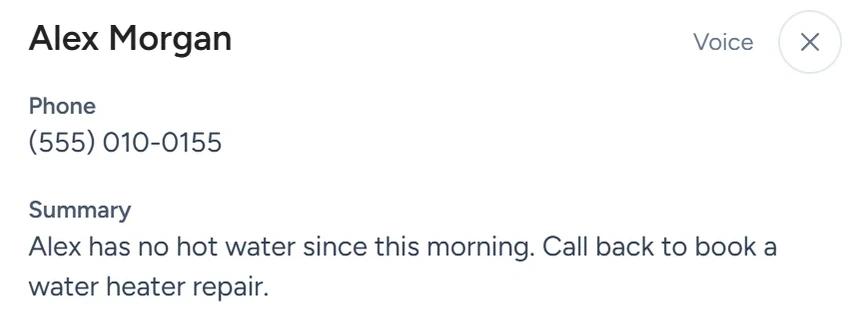
- It sends you a record of the call. A live service sends the message by email or text. An AI receptionist sends a written summary.
A phone menu stops after step two: it plays your greeting and routes the caller.
What are the benefits of using a virtual receptionist?
The main benefit of a virtual receptionist is that your phone is answered in the hours nobody is at the desk. A full-time receptionist is there for 40 of a week’s 168 hours, and customers don’t keep office hours: 38% of a sample of 7,159 website chats arrived after hours.
Two more benefits come with some kinds:
- Several calls at once. An AI receptionist can answer two callers at the same moment.
- Every call in writing. A live service and an AI receptionist send you each call in writing, so a job doesn’t depend on someone remembering to pass it on.
One job stays with a person at a desk: the visitor at the door.
What a virtual receptionist costs at 100 calls a month
A virtual receptionist costs from $20 a month for each person on a phone menu plan to $1,988 or more for a remote receptionist you hire.
Cost a month, cheapest first
Lowest priceHighest price
| Kind | Cost a month |
|---|---|
| A phone menuFor each person on your phone plan | $20 to $33 a user |
| An AI receptionistBilled by the call or the minute | $70 to $213 |
| Small Business ChatbotOur AI receptionist, on Self Serve or Managed | $99 or $249 |
| A live receptionist serviceBilled by the minute or the call | $275 to $1,725 |
| A remote receptionist you hireOne person, full time | $1,988 to $5,400 |
| A receptionist on your own staffFor comparison: the median full-time wage | $3,168 |
A phone menu, an AI receptionist and a live service all cost less than a receptionist on your own staff, who earns $3,167.50 a month at the US median wage, before taxes and benefits.
For every company by name, see what each of the 18 services costs at your own call volume.
Which kind of virtual receptionist fits your business
It depends on how many calls you get and what your callers need.
- A few routine calls a week: voicemail or a phone menu.
- Around 100 calls a month of questions, bookings and messages: an AI receptionist or a live service.
- A full day of phone and admin work: a remote receptionist you hire.
Three questions settle it.
How many calls do you get a month?
Four calls a day is 84 calls a month on 21 working days and 120 on all 30. That is the 100-call month priced above, where a live service or an AI receptionist fits. To see what the calls you miss now are worth, run your own count through the missed-call revenue calculator.
Under about 30 calls a month, pay by the call. On a live service’s 10-call plan, a person answers up to 29 calls for under $100 a month.
A 10-call plan at $50, extra calls $2.50 each
20 calls: $50 + 10 × $2.50= $75
29 calls: $50 + 19 × $2.50= $97.50
AI plans go lower: one is free for the first 25 calls a month.
When voicemail is enough
Voicemail is enough for a few routine calls a week from people who will leave a message.
Asked on the BiggerPockets forum whether anyone uses an after-hours answering service, a landlord who manages 30-plus rental properties himself replied in 2019: “There simply are not enough actual emergencies to warrant the need.”
What do your callers need?
If callers only want a named person or department, a phone menu does it. If they want an answer, a booking or a message taken, that takes an AI receptionist or a live service.
If you think your callers will mind a machine, two of the four kinds are people. In a survey of 6,000 consumers, 89% said they prefer a real person to a bot when they call a law firm, and 85% said a firm should say clearly when the caller is talking to AI (Attorney at Work, Sep 3, 2026). A live receptionist service published the survey, and it asked only about law firms.
Pay for a person when the call needs someone to decide what to do, such as a complaint or an upset customer. Our answering service guide lists when a live service is the better choice.
Which hours do you need covered?
For business hours only, any of the four will do. Nights and weekends rule out the hired person, who works one shift. That leaves an AI receptionist, or a live service whose plan includes those hours. A trade with emergencies at night needs one of the two (see the AI answering service for plumbers).
Read the plan before you sign: a live service can add a surcharge for nights and weekends.
Setting it up: forwarding, your number and what you give it
You keep your number, because calls reach a virtual receptionist by call forwarding. There are four jobs to do.
- Choose the calls. Every call, or only the ones you don’t pick up; all day, or only after hours.
- Forward your line. Use your phone carrier’s call forwarding. For our AI receptionist, the help guide shows how to get a number and forward your line to it. A phone menu is switched on inside the phone system itself.
- Tell it what to say. A live service needs your script, a hired person your training, an AI receptionist your written instructions, and a menu your recorded greeting and its options. Be detailed: it works from what you give it.
- Call it yourself. Ring your number from another phone, ask what your customers ask most, and read what reaches you afterwards.
My take
If someone already answers your phone during the day, keep them. Forward the calls they miss, at night and on weekends, to an AI receptionist. I’d pick one that also answers your texts and website chat, which is why Small Business Chatbot is my first pick.
How we checked these prices
- Every price is from the company’s own page.We read MyOutDesk’s, Wishup’s, RingCentral’s, GoTo Connect’s and Quo’s pricing and feature pages on Nov 5, 2026, and the pricing pages of ten live services and eight AI services on Nov 4, 2026.
- The wage is the government’s figure.It is the US Bureau of Labor Statistics’ median wage for receptionists in May 2025, $38,010 a year (read Nov 5, 2026), and it counts wages and nothing else an employer pays.
- Every kind is priced for the same month.We assumed 100 calls of 3 minutes each and took the cheapest published plan that covers them, extra calls or minutes included, before tax.
- Where a page gave no figure, we say so.GoTo Connect publishes no price, Ruby publishes no price for extra minutes, and the staffing companies’ pricing pages give a hired receptionist’s price and hours without the duties.
- We read how sellers use the name.Ruby’s, Wishup’s, MyOutDesk’s and Moneypenny’s guides were read on Nov 5, 2026; Vonage’s page title is taken from Google’s listing of Oct 27, 2026, because the page itself would not open on Nov 5.
- We make one of the products.Small Business Chatbot publishes this guide and is one of the AI receptionists priced here; its facts come from our pricing page and help guides (read Nov 5, 2026), and the after-hours share is our own count of website chats, which is a different thing from phone calls.
- AI helped, a person decided.The page was researched and drafted with AI tools, then reviewed and edited by Arthur Cockfield.
How each price adds up
- Phone menu: RingCentral’s RingEX plans start at $20 for each user, paid annually, and Quo’s Business plan is $33 for each user, paid monthly. Three users come to $60 to $99. GoTo Connect publishes no price.
- AI receptionist: Upfirst is $59.95 for 90 calls + 10 × $1.00 = $69.95. Smith.ai’s AI Pro plan is $150 for 75 calls + 25 × $2.50 = $212.50.
- Small Business Chatbot: Self Serve includes 100 answered calls, then $0.75 a call. Managed includes 500, then $0.50 a call.
- Live service: ReceptionHQ’s 100-call plan is $275. At Ruby, 100 three-minute calls are 300 minutes; its 200-minute plan is too small and Ruby publishes no price for extra minutes, so the smallest plan that holds them is the 500-minute plan, $1,725. Smith.ai, the next highest, is $810 for 90 calls + 10 × $10.50 = $915.
- Hired receptionist: MyOutDesk’s $1,988 is one person, eight hours a day, five days a week. Wishup’s $5,400 is its US-based plan, 9 am to 6 pm, Monday to Friday.
- Under 30 calls a month: The 10-call plan at $50, then $2.50 a call, is ReceptionHQ’s. The AI plan that is free for the first 25 calls a month is Smith.ai’s.
- Extras: Smith.ai adds $1.50 a call for booking, and Dialzara’s transfers are on its $349 plan. ReceptionHQ’s pricing page says a surcharge applies outside 5 am to 7 pm Mountain time on weekdays and does not give the amount; its message-only plan, MessageExpress, starts at $25, below ReceptionistPlus at $40.
Questions
Is a virtual receptionist a real person?
Sometimes. Two of the four kinds are people: a live receptionist service and a remote receptionist you hire. An AI receptionist is software that holds a conversation, and a phone menu is a recorded greeting.
Is a virtual receptionist the same as an answering service?
A live virtual receptionist service and an answering service are the same kind of company. A hired remote receptionist, an AI receptionist and a phone menu are the other three kinds of virtual receptionist.
Does the caller know the receptionist is remote or an AI?
With a live service or a hired receptionist, the caller hears a person answer in your company’s name. With an AI receptionist you write the greeting, so how it introduces itself is your choice.
Can a virtual receptionist book appointments and transfer calls?
Yes for a live service and an AI receptionist, on plans that include it. Some plans charge extra for booking or keep transfers for a higher plan. A phone menu sends the caller to a person, a department or voicemail. A hired receptionist does what you train them to do.
Do virtual receptionists answer at night and on weekends?
It depends on the kind. A hired receptionist works one shift. An AI receptionist answers at any hour, and a live service answers nights and weekends when its plan includes them.
Can I keep my business phone number?
Yes, when calls reach the virtual receptionist by call forwarding: your customers keep dialing the number they always have.
Is a virtual receptionist worth it if I only get a few calls a week?
Often not. Voicemail is enough for a few routine calls a week from people who will leave a message. Under about 30 calls a month, pay by the call: on a 10-call plan at $50, a person answers up to 29 calls for under $100 a month.
See how Small Business Chatbot would answer your calls
Paste your website and Sarah, our AI receptionist, builds a preview from it. No signup.
Or call her now: (646) 759-1090
Arthur Cockfield
Arthur Cockfield is the co-founder of Small Business Chatbot, which builds AI front-desk assistants for small businesses. Earlier he was an early employee and Head of Growth at OneLocal (YC S17), where he worked with hundreds of service-based small businesses on their marketing.